Start with the unfinished job
Choose the action you need help with before comparing products. Is the powder difficult to carry, hard to direct into the bottle, not yet measured, or ready to mix? The answer determines which accessory features matter.
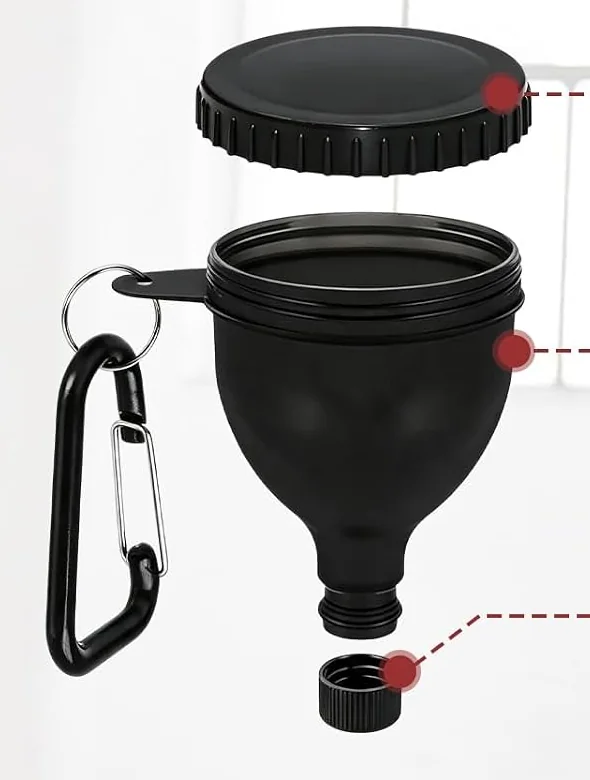
Seller-supplied illustration of the carry-and-transfer container discussed here.
Compare the four roles
| Accessory | Job it can address | Check before choosing |
|---|---|---|
| Open funnel | Guide powder into an opening | Outlet clearance, support and separate powder storage |
| Capped funnel container | Carry dry powder, then release it through an outlet | Planned amount, closures, receiving-bottle fit and care |
| Scoop or scale | Measure an amount | Powder label directions and the tool’s suitability |
| Shaker bottle | Receive contents for mixing | Bottle capacity and its own mixing instructions |
Some accessories combine functions, so read the actual specification rather than relying on the product name. A combined scoop-and-funnel sold elsewhere does not establish a measuring scale on this container.
Match the featured container to the job
This item’s seller-stated features are 50 mL capacity, PP material, two caps and a carrying clip. Its wide top loads the reservoir and the lower outlet releases the contents. The material’s approximate 20 g example depends on the powder; no calibrated graduations are supplied.
NIST’s units reference distinguishes mass from volume. Use the powder’s own directions for measuring instead of treating storage volume as a universal weight.
Make a task-based choice
- For carrying, check whether your planned amount fits with normal cap closure.
- For transfer, check the actual outlet and receiving opening.
- For measuring, identify the label instruction and an appropriate tool.
- For mixing, consult the receiving bottle’s instructions.
Return to the powder funnel task overview to choose the relevant role.